Arizona Education Progress Meter 2026 Updates
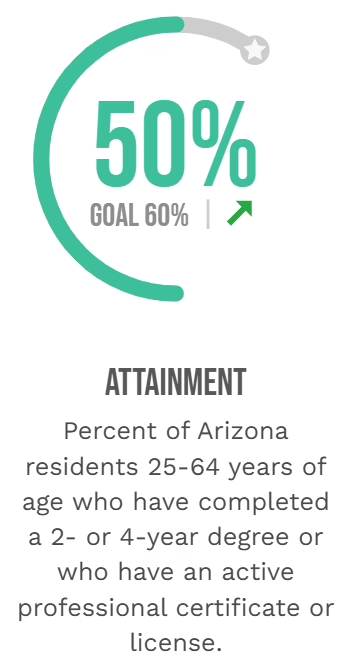
The latest Arizona Education Progress Meter data shows meaningful progress and important work ahead across our state’s education continuum. Most notably, Arizona’s postsecondary attainment rate has reached 50% (up 1 percent from the previous year), marking continued positive movement toward the state’s Achieve60AZ goal, where at least 60% of Arizonans will hold a postsecondary degree or credential by 2030. That increase represents approximately 30,000 additional degrees, certificates, and licensures for Arizonans. The report, Billions to Gain, shows that just this 1% increase potentially means tens of millions of dollars in new revenue for Arizona.
Education and the economy must be seen as inextricably linked, especially in Arizona. In a state experiencing rapid economic growth, particularly in high-tech, advanced manufacturing, and other high-wage, high-skill sectors, this progress is essential. As companies expand and new employers weigh Arizona against other states, Arizona’s ability to produce more and more talent remains the key driver of future competitiveness.
Strengthening educational attainment along the entire education spectrum ensures more Arizonans are ready to fill competitive jobs for growing industries. This makes moving a company here more appealing – thereby leading to an increase in the quality of life for individuals, communities and a more vibrant state economy.
Key Milestones Along the Education Continuum

Across the earlier stages of the education pipeline, the data highlights places where more attention is needed. While quality early learning stands at 31%, holding mostly steady from the previous year, Arizona families and employers continue to face significant childcare shortages that make it difficult for parents to fully participate in the workforce and pursue additional education and training. These gaps limit opportunities for families and create ongoing challenges for employers across the state, with rural communities often facing the greatest barriers.
At the K–12 level last year, 36% of third graders were proficient in reading and 27% of eighth graders were proficient in math, representing declines in both foundational indicators. Reading and math are critical to ensure students have the skills they need to be successful after high school in furthering their education and in the 21st century job market. A renewed focus on increasing third-grade reading proficiency is being called for across the state at both the county and local levels, as districts look to implement as many of Arizona Literacy Plan 2030 strategies as possible. These strategies have been proven to be successful across many other states and Arizona is behind.
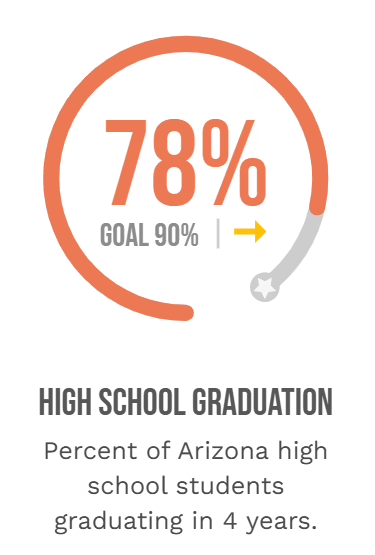
In addition, the high school graduation rate remained steady at 78%, but that number needs to rise to ensure all students are prepared to successfully pursue the education and training they will need after high school to attain a life-changing, high-wage, high-skill job. In the highest performing states across the country, high school graduation rates top 90%. Arizona’s high school graduation rate ranks among the lowest in the nation.
Together, these dynamics highlight the importance of ensuring all students and families, regardless of educational setting or background, have access to strong, quality learning and K-12 instruction, including the foundational literacy and math skills needed for long-term success.
Shifting Dynamics Across Arizona’s K–12 Landscape
Arizona’s K12 landscape is changing as Empowerment Scholarship Accounts (ESAs) expand educational options and competition for public school students. ESA competition for students combined with a lower birth rate and an increased cost of living in Arizona, have many public K12 schools across the state seeing declining enrollment leading to school closures and fewer teaching positions. The full effect of these factors will be seen in the coming years.
In addition, recent polling from Education Forward Arizona, shows Arizona voters expressing growing interest in stronger accountability and transparency within the ESA program with concern for how public tax dollars are being spent and a focus on outcomes to ensure students are prepared for postsecondary education and training or workforce opportunities.
Building a Stronger Postsecondary and Workforce Pipeline
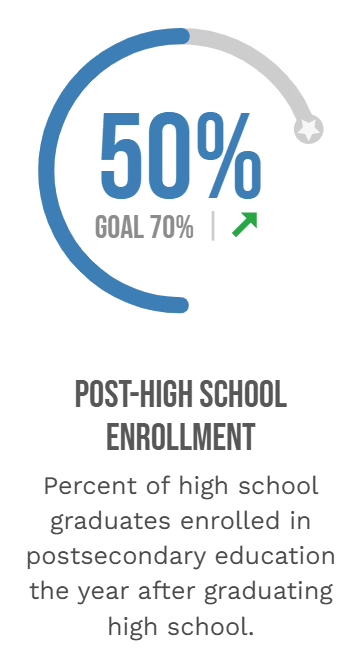
Enrollment in education after high school has continued to climb after a multi-year low of 47% in 2020. Last year, the rate of high school graduates enrolling in postsecondary education, within a year of graduating from high school, was up to 50%. That number needs to continue to increase significantly to ensure students have the skills and training they need to successfully pursue the jobs available in Arizona right now and in the future.
Encouragingly, the percentage of young people ages 16–24 who are disconnected from both school and work has declined to 11% from many years spent at 12%. Because reducing this metric is the goal, the drop represents meaningful progress toward reconnecting more young Arizonans to education, training, and career pathways. Continued collaboration among schools, higher education institutions, workforce partners, and employers will be critical to building on this momentum.
Annual national comparisons illuminate why there’s more work to be done. In the 2026 WalletHub national ranking of “Most & Least Educated States,” Arizona places in the middle of the pack, ahead of several states but still below many others in overall measures of education quality and attainment.
Finally, it is important to note that some of the increase in attainment is due to individuals moving to the state with higher levels of education and training, making it more important than ever that Arizona prioritizes access to high quality education and training for those coming up through the Arizona education pipeline.
Together, this year’s update tells a clear story: Arizona is making measurable gains in expanding educational attainment and strengthening its workforce pipeline, but additional work on the education pipeline is needed because some of these “gains” are influenced by individuals moving here and are not driven by Arizonans progressing through our state’s education pipeline. Continued focus and investment across early learning, K–12 education, and postsecondary pathways will ensure that more students succeed, and that Arizona’s economy continues to grow with opportunity for all.
By the numbers:
| Indicator | Current Data Timeframe | Previous Percent | Current Percent | % Change Between Years | Goal |
|---|---|---|---|---|---|
| Quality Early Learning | 2024 Year | 32% | 31% | -1% | 45% |
| Third-Grade Reading | 2025 Cohort | 39% | 36% | -3% | 72% |
| Eighth-Grade Math | 2025 Cohort | 28% | 27% | -1% | 69% |
| High School Graduation Rate | 2024 Cohort | 78% | 78% | No change | 90% |
| Opportunity Youth | 2024 Year | 12% | 11% | -1% | 7% |
| Post-High School Enrollment | 2024 Cohort | 49% | 50% | +1% | 70% |
| Post-Secondary Attainment | 2024 Year | 49% | 50% | +1% | 60% |
Stay connected to the latest education and workforce updates shaping Arizona’s future.
Subscribe to Education Forward Arizona’s newsletter for new research, student stories, statewide progress updates, events, and ways to stay informed and engaged.