Education Forward Arizona Urges a “No” Vote on Proposition 320
Today, Education Forward Arizona President and CEO Rich Nickel issued the following statement on Proposition 320, which was referred to the ballot by the Arizona State Legislature, and will appear on all Arizona voters’ ballots. Ballots are set to be mailed on October 7. Election Day is November 3.
Arizona’s students deserve schools that give them every opportunity to learn, grow, and prepare for success after high school. Decisions about how schools allocate their resources should strengthen those opportunities, and the public should have a clear understanding of what will change.
Proposition 320 falls short of that standard; it asks voters to approve a consequential school-spending mandate without defining which expenses would count toward it. It provides no new funding and guarantees no teacher a raise. Yet complying with it could require districts to eliminate services that students and families depend on.
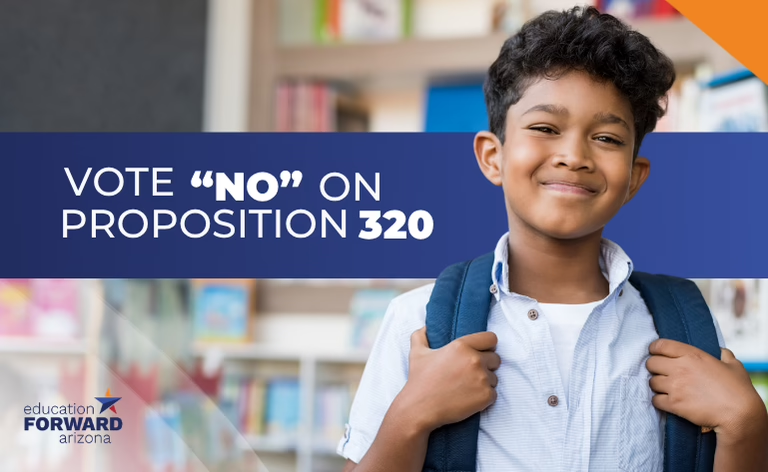
Education Forward Arizona urges Arizonans to vote ‘No’ on Proposition 320.
The measure would require affected school districts to devote at least 60% of operational spending to direct instructional expenses, with annual increases required for those below the target. But it omits any precise definition of what direct instructional expenses are, leaving it to the Auditor General to define them after the fact if the measure passes.
In effect, voters are being asked to approve the mandate now and trust that the details will work out in the end. That is a risky approach to highly consequential decisions affecting students and schools. Voters should be able to understand what qualifies as instructional spending before they cast their ballots. That clarity is especially important for a voter-approved law that would be difficult to change.
Additionally, the promised benefits are uncertain. A higher spending percentage does not, by itself, guarantee better-paid teachers or additional classroom resources. With no new funding provided by the measure, affected districts would have to redirect existing dollars to satisfy the formula. This amounts to a constraint on districts’ flexibility and local control over resource allocation in that only a specific set of centrally mandated, yet-to-be-defined operational expenditures will qualify as direct instruction. District and school leaders would have to make budget decisions within that requirement, not necessarily in the best interests of student learning.
These tradeoffs belong at the center of this discussion. They could mean that some schools provide fewer essential services and have more limited resources for students and their families. Services and resources, ranging from transportation and building maintenance to sports programs and school cafeterias, may be at risk. Crucial educational supports and services, such as counseling, special education instruction, and literacy coaching, could be cut.
All these elements contribute significantly to student learning and their school experience. Learning extends beyond the classroom, and classroom teachers work within a larger constellation of people, services, and resources that support each student’s learning. Schools are strongest when those elements reinforce one another.
Proposition 320 leaves voters without a clear accounting of how these and other functions would be treated under its spending requirement and proposes a budget formula that could diminish the very educational and learning opportunities it purports to strengthen.
The penalties that are written into Proposition 320 create an additional risk. Districts that do not comply could lose funding that supports teacher compensation and other student needs, leaving schools with fewer resources to do the work Arizona expects of them.
Smart public investment in our schools starts with clear purposes, transparent rules, and a careful assessment of consequences for students. Arizona should expect that of any proposal governing school spending. Proposition 320 does not meet those basic criteria. Instead, it asks voters to accept too much uncertainty, with too much at stake.
Vote “No” on Proposition 320.