We Are Getting the Outcomes We Invest In
Arizona’s FY2027 budget is delivering exactly the education outcomes we are investing in. At a time when the state says it wants stronger schools, higher attainment, and a more competitive workforce, this budget falls short of what those goals require.
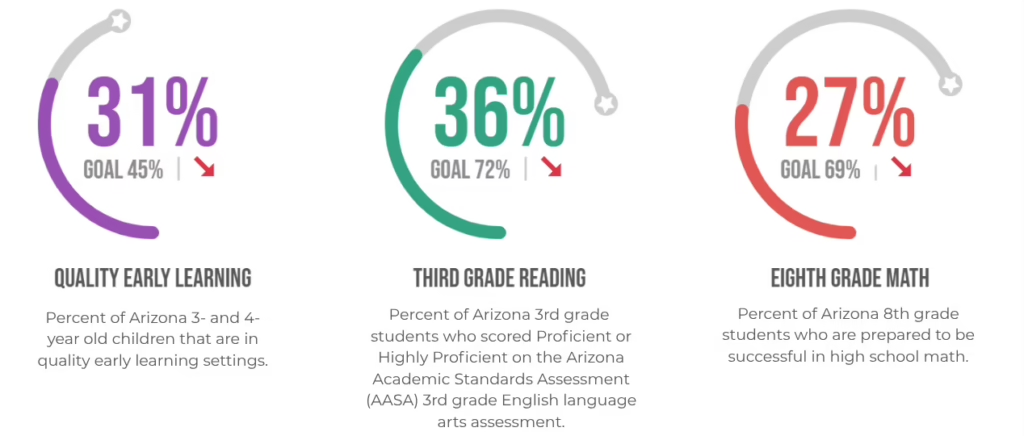
The elimination of key education and workforce investments, cuts to public universities, continued lack of support for Maricopa and Pima community colleges, failure to advance a Prop 123 renewal, and lack of ESA accountability measures collectively weaken Arizona’s education‑to‑workforce ecosystem. These choices come just as the Arizona Education Progress Meter shows the state sliding backward on several basic but critical indicators, including quality early learning, third grade reading, and eighth grade math. For example, third grade reading proficiency has declined by three percentage points over the past year.
Of concern is not only the specific cuts but also what they signal about the state’s commitment to remaining competitive and to preparing Arizonans for the careers of the future. In many respects, Arizona is now seeing the consequences of decisions it has made over time.
State leaders have chosen a tax and budget structure that leaves fewer dollars available for education. Strong schools, colleges, universities, and workforce training programs require sustained, strategic investment. This budget does not meet that standard, and the results will show up in classrooms, campuses, and workplaces across Arizona.
Meanwhile, Arizona voters have been clear. Education Forward Arizona’s research shows that voters expect the state to make education a top priority and understand that a competitive economy depends on strong schools, accessible postsecondary education, and effective talent creation. The disconnect between voter expectations and the decisions reflected in this budget should be deeply concerning to everyone who cares about the future of the State’s economy.
Eliminated education and workforce investments
The FY2027 budget eliminates several one-time investments funded in FY2026, including:
- Dual Enrollment ($1.5 million)
- Arizona Promise Program ($16.3 million)
- Adult Workforce Diploma Program ($2.0 million)
- Adult Education Workforce Program ($6.0 million)
- Ninth Grade On‑Track Initiative ($3.4 million)
- Adult Education Skills Program ($1.0 million)
These investments helped Arizona students and adult learners build the skills, earn the credentials, and access the opportunities needed to succeed in high-wage, high-demand careers that are critical to Arizona’s current and future economy. Dual enrollment is a proven strategy for helping more students persist in postsecondary education and move into high‑demand careers. We should be increasing our investment here. Eliminating them sends the wrong message at a time when employers across the state continue to report workforce shortages and rising demand for skilled talent.
When Arizona pulls back from programs that work, it can expect slower progress on attainment, more difficulty filling critical jobs, and fewer Arizonans able to take advantage of emerging economic opportunities. Budgets are statements of priority. This one says that proven talent‑building strategies are not at the top of Arizona’s list.
Cuts to Arizona’s public universities
The budget also reduces funding for Arizona’s public higher education system:
- Arizona State University: cut $8.0 million
- Northern Arizona University: cut $2.6 million
- University of Arizona—Main Campus: cut $4.7 million
- University of Arizona—Health Sciences Center: cut $1.0 million
Arizona’s public universities are among the state’s most important engines of talent development, research, innovation, and economic growth. They educate tens of thousands of students and adult learners each year and produce thousands of well-prepared future employees which help attract companies that depend on a skilled workforce.
Reducing investment in these institutions undermines efforts to increase educational attainment and build the workforce Arizona needs to remain competitive. Other states are making large, sustained investments in public higher education as a core economic strategy. Arizona cannot afford to keep moving in the opposite direction and still expect to compete.
Missed opportunities
In addition to these cuts, the FY2027 budget misses several opportunities to strengthen Arizona’s education system and workforce pipeline.
- It includes no funding for literacy coaches, despite continued declines in reading proficiency and despite Arizona Literacy Plan 2030 identifying literacy coaching as a key strategy to improve reading outcomes. The final budget failed to support even a modest $2 million investment in literacy coaching—an amount that is small in the context of the overall budget but significant for schools and students who need additional support to read on grade level by third grade. Currently only 36% of Arizona third graders are proficient in reading.
- It includes no additional ESA accountability measures, even as program costs grow and likely impact other parts of the budget. Polling shows that Arizona voters want greater transparency and accountability to ensure public education dollars are used effectively and responsibly. Failing to provide that accountability risks eroding public trust and weakening support for education investments over time.
- It once again provides no direct operating support for Maricopa Community Colleges and Pima Community College. These institutions serve hundreds of thousands of students and are among the state’s most important providers of workforce training, technical education, adult education, industry certifications, and short‑term credentials. Leaving them without state operating support, year after year, is out of step with their central role in Arizona’s talent pipeline.
- It does not include sending a renewal of Prop 123 back to voters for November’s election. This means that the approximately $300 million owed to schools annually is now coming out of the state’s general fund rather than the state land trust, which further strains limited resources.
Taken together, these omissions represent missed opportunities to invest in practical, evidence-based strategies that help students stay on track and employers find the talent they need. Arizona is not just spending too little; it is spending too little on the very things its own plans and data say matter most.
Renewed but limited investments
To be fair, the budget does maintain some important education‑related investments:
- $44.8 million in one‑time childcare funding, helping working families remain connected to the workforce and supporting employers that rely on a stable labor force.
- $3 million in continued one‑time funding for out‑of‑school time programs, helping students stay engaged and supported beyond the classroom.
- Continued one‑time support for District Additional Assistance and the Opportunity Weight Group, providing additional resources for K‑12 schools.
These are positive steps, and they should be recognized as such. But they do not change the larger story. The state is still underinvesting in several of the strategies most directly tied to improving student outcomes and building a strong workforce.
Arizona’s attainment goal and competitiveness are at risk
Despite these challenges, Arizona has made meaningful progress toward its goal of ensuring that 60 percent of working‑age adults hold a degree, certificate, or other high‑value credential by 2030. Attainment is now at approximately 50 percent. That progress demonstrates that educators are working hard and delivering results with extremely limited resources.
However, reaching the statewide goal will require sustained, targeted investments in the programs that help learners earn credentials, access career opportunities, and meet employer demand. Eliminating proven investments and cutting key institutions now makes that climb steeper, not easier.
Arizona’s business, education, and community leaders consistently identify talent creation as one of the state’s top economic priorities. There are tremendous opportunities for Arizonans to become part of a highly skilled workforce, but those opportunities depend on a strong education system from early literacy through postsecondary education and training.
Arizona is getting the education outcomes it is investing in. If state leaders want better results—in reading, in attainment, in workforce readiness—the state must make different choices. That means aligning budgets with Arizona’s stated goals, funding the strategies that data and experience show will work, and ensuring that every learner has a real pathway to succeed in education, career, and life.
We are here by design. If Arizona wants different outcomes, our leaders will have to make different choices.