Education Forward Arizona Releases Third White Paper in Education-to-Workforce Series
New paper makes the case for intentional statewide coordination to strengthen student opportunity, talent development, and Arizona’s economic competitiveness
Education Forward Arizona today released the third paper in its Education-to-Workforce Whitepaper Series, making the case that Arizona needs a clearer and more sustainable way to coordinate the many systems, institutions, and organizations that shape student opportunity, workforce readiness, talent development, and economic growth.
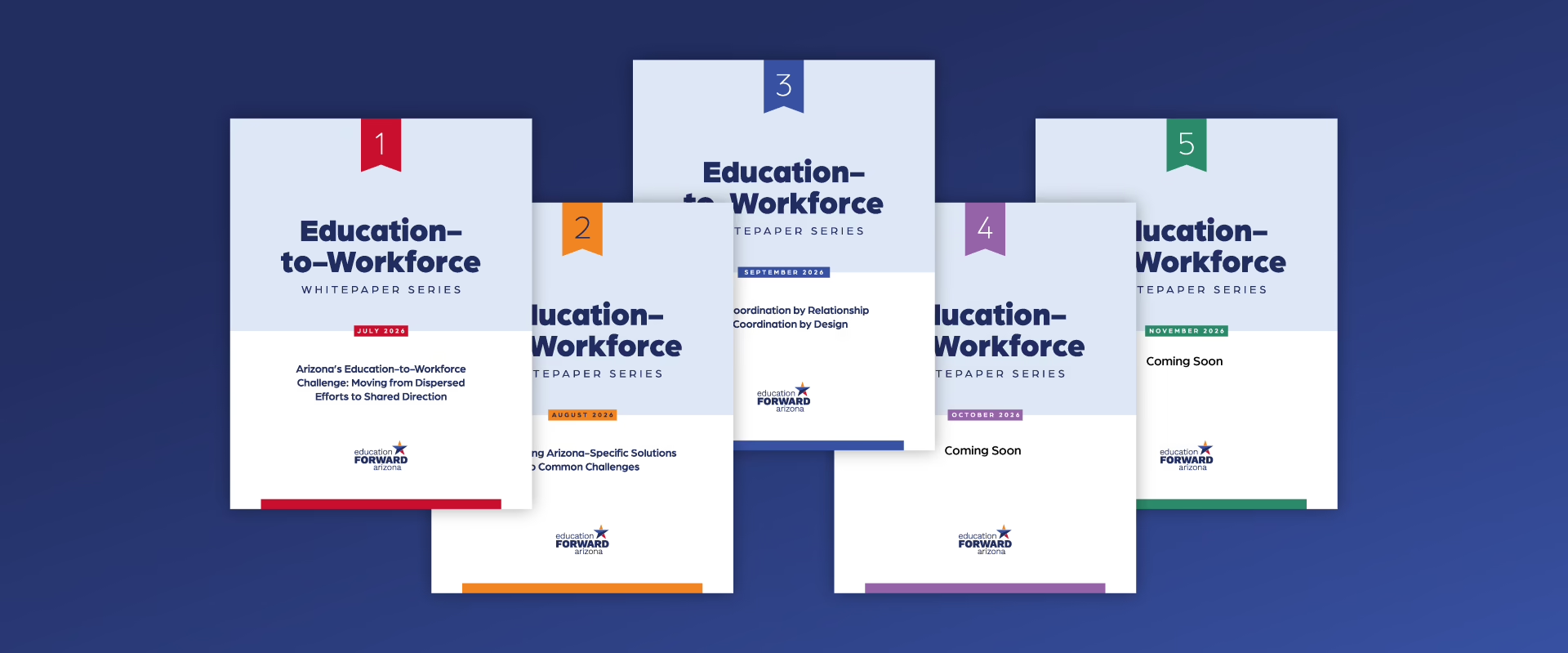
The new paper, From Coordination by Relationship to Coordination by Design, argues that Arizona has many important education-to-workforce assets already in place, including formal workforce structures, state-level talent initiatives, labor-market data capacity, strong educational institutions, regional partnerships, employer engagement, and community-based supports. Yet those assets do not currently add up to an intentionally designed statewide system for education-to-workforce coordination.
The paper does not recommend one specific structure. Instead, it emphasizes that the form Arizona chooses must be developed intentionally. A compact, commission, public-private framework, strengthened existing structure, shared responsibilities agreement, or another statewide approach could all be considered. The central question is whether the chosen approach can sustain the work Arizona needs: clearer communication, stronger use of shared data, regular convening, visible regional learning, and follow-through across systems.
“Arizona has many strong education, workforce, business, and community partners doing important work,” said Ricardo Lopez Valencia, Senior Vice President of Education and Workforce Alignment at Education Forward Arizona. “If we want students and families to navigate pathways more clearly, and if we want employers and regions to plan for talent more reliably, coordination has to be designed with intention.”
Arizona has already designed coordination within the public workforce system through the Workforce Arizona Council and ARIZONA@WORK. But the broader education-to-workforce continuum includes K-12 education, career and technical education, community colleges, universities, career advising, credential pathways, employer engagement, economic development, and community-based supports. No equivalent statewide structure currently connects that broader landscape in a consistent and durable way.
For students and families, stronger coordination could make education and career pathways easier to understand and navigate. Students may encounter career and technical education, dual enrollment, industry credentials, apprenticeships, community college programs, university pathways, adult education, scholarships, short-term training, and work-based learning without a clear picture of how those options fit together. A better coordinated system would absorb more of that complexity rather than leaving students and families to navigate disconnected systems on their own.
For employers, stronger coordination could create clearer channels to communicate demand, support work-based learning, and help education and training partners understand where skills, credentials, and experience are most needed. Arizona’s long-term economic competitiveness depends on both attracting talent and preparing more Arizonans for opportunity in the state’s changing economy.
“Arizona’s economic future depends on whether we can connect education, training, talent development, and employer needs more clearly and consistently,” said Rich Nickel, President and CEO of Education Forward Arizona. “This is not about centralizing control. It is about creating a more coherent system that helps students see opportunity, helps regions strengthen local pathways, and helps employers plan for the workforce they need.”
The paper identifies three responsibilities that any statewide coordinating mechanism should be expected to sustain: clear communication, data analysis and publication, and regular convening and collaboration. Together, those functions would help Arizona explain how the ecosystem works, review progress and gaps more consistently, elevate regional models, clarify responsibilities, and keep students and families at the center of education-to-workforce conversations.
The paper also emphasizes that statewide coordination should strengthen regional work, not replace it. Arizona’s regions differ in their economies, industries, populations, transportation challenges, institutional capacity, and access to postsecondary options. A strong statewide approach would help regional and local efforts become more visible and better connected to statewide decisions, while making statewide priorities more useful to the institutions and organizations responsible for implementation.
The Education-to-Workforce Whitepaper Series will continue in the coming months. Future papers will examine funding and accountability levers and practical steps Arizona can take to strengthen alignment statewide.
The third white paper in the series is available here.
About Education Forward Arizona
Education Forward Arizona is a statewide advocacy organization keeping education at the center of the conversation and advancing pathways to economic opportunity; a high-demand, highly skilled, high-wage workforce; and a stronger Arizona. Working directly and in partnership with education, business, and civic leaders, Education Forward Arizona helps drive progress toward the state’s postsecondary attainment goal, Achieve60AZ, a key indicator on the Arizona Education Progress Meter. This includes advocating for policies, funding, and cross-sector strategies that support progress for communities statewide. Its work spans the education continuum—from early learning through postsecondary education and workforce training—and includes scholarships and mentoring that help Arizonans gain skills and credentials.
Learn more at EducationForwardArizona.org.